
The Hidden Mental Load of Modern Driving — And the Technology Trying to Solve It
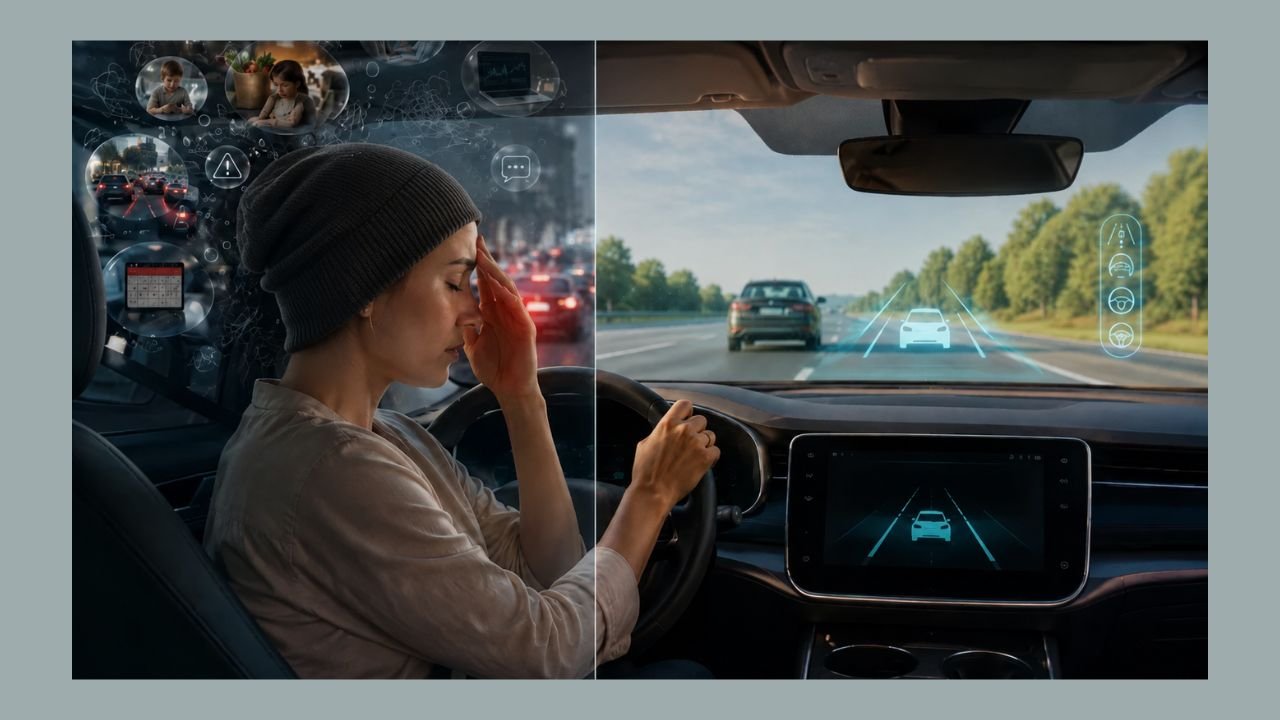
Modern driving is often discussed in terms of safety, fuel economy, or performance. Far less attention is given to the quieter psychological strain that increasingly shapes the experience behind the wheel. Yet for many drivers, particularly in urban and suburban environments, the mental effort involved in everyday motoring has become one of the defining realities of modern transport.
Congestion, navigation decisions, parking pressure, unpredictable traffic systems, constant notifications, and sensory overload all contribute to a form of cognitive fatigue that many motorists recognize instinctively, even if they rarely describe it directly. Driving no longer feels like a simple mechanical task. In many situations, it resembles a continuous exercise in information management.
At the same time, automotive technology is evolving rapidly in response. Driver-assist systems, automation, connected navigation, and intelligent cabin design are increasingly being developed not simply to improve convenience but to reduce mental strain itself.
Driving Has Become a Constant Cognitive Exercise
For much of the twentieth century, driving demanded physical attention more than mental multitasking. Roads were quieter, in-car distractions were limited, and journeys were often less compressed by scheduling pressures.
Today’s driving environment is fundamentally different.
A typical commuter may simultaneously monitor navigation prompts, speed cameras, cyclists, changing lane restrictions, parking availability, fuel or battery range, and incoming calls — all while processing increasingly dense road infrastructure. Add children in the back seat, poor weather, or unfamiliar roads, and the cognitive load rises considerably.
Even relatively short journeys can leave drivers mentally exhausted.
This is particularly noticeable in cities, where modern road systems require near-constant decision-making. Multi-lane roundabouts, temporary roadworks, low-traffic neighborhood schemes, electric vehicle charging logistics, and app-based parking systems all demand ongoing attention. Driving is no longer passive transport; it is active information processing.
The issue is not simply distraction. It is an accumulation.
Parking Stress Has Become Its Own Category of Fatigue
Among the most underestimated sources of driving anxiety is parking.
Research into urban mobility increasingly shows that drivers often perceive parking as more stressful than the journey itself. The pressure to find spaces quickly, interpret restrictions correctly, avoid fines, and maneuver safely in tight areas creates a surprising amount of psychological strain.
This is especially true in the UK, where parking regulations vary significantly between councils and private operators. Drivers frequently face unclear signage, narrow residential streets, and limited availability in densely populated areas.
As vehicles themselves have grown larger, parking has also become more technically demanding. SUVs and family crossovers dominate many roads, yet older parking infrastructure was not designed with these dimensions in mind.
Manufacturers have responded accordingly. Automated parking systems, 360-degree cameras, proximity sensors, and cross-traffic alerts are no longer premium novelties reserved for luxury vehicles. They are increasingly becoming mainstream expectations because they directly reduce stress levels during low-speed maneuvering.
For many drivers, the value of these systems lies not in convenience but in emotional relief.
Driver-Assistance Technology Is Shifting the Nature of Driving
Much of the current conversation around automotive technology focuses on autonomous vehicles, but the more immediate transformation is happening through partial automation.
Adaptive cruise control, lane-keeping assistance, fatigue monitoring, and predictive braking systems are quietly reshaping everyday driving behavior. These features reduce the number of constant micro-decisions drivers need to make, particularly during long motorway journeys or in heavy traffic.
Adaptive cruise control is a useful example. Maintaining safe following distances in stop-start traffic may sound simple, but it requires continuous concentration over extended periods. Systems that automate this process reduce repetitive mental effort, allowing drivers to focus more broadly on surrounding conditions.
Similarly, lane assistance systems reduce the subtle but persistent cognitive drain associated with motorway positioning. Fatigue detection software monitors steering behavior and alerts drivers when concentration appears to decline.
These technologies are not eliminating driver responsibility, but they are redistributing cognitive effort in ways that matter psychologically.
The Cabin Itself Is Being Redesigned Around Mental Comfort
An interesting shift within automotive design is the growing focus on emotional ergonomics.
Manufacturers increasingly understand that the atmosphere inside a car directly affects driver stress levels. As a result, cabin design has moved beyond aesthetics into areas traditionally associated with psychology and behavioral science.
Quieter electric drivetrains, ambient lighting systems, simplified dashboard layouts, and voice-controlled interfaces all help reduce sensory overload. Some manufacturers are even introducing wellness-focused features such as air purification systems, massage seating, and adaptive lighting modes designed to improve focus or reduce tension during longer journeys.
This reflects a broader shift in how vehicles are culturally positioned. Cars are no longer viewed solely as transport machines. They are personal environments where people spend large portions of their daily lives.
That shift also explains the continued importance of vehicle identity and personalization. Drivers increasingly want cars that feel psychologically comfortable and reflective of their personalities. For some motorists, that extends beyond interior features to the vehicle’s exterior presentation. Brands such as Number 1 Plates sit within this wider culture of automotive individuality, where even small design choices contribute to a driver’s sense of ownership and connection with the vehicle.
Electric Vehicles Introduce New Forms of Mental Management
While electric vehicles remove some traditional stresses associated with combustion engines, they also introduce new cognitive considerations.
Range management, charging availability, app integration, and route planning all require different forms of attention. Drivers must think more strategically about longer journeys, particularly in areas where charging infrastructure remains inconsistent.
However, EVs also demonstrate how software is becoming central to the driving experience. Intelligent route planning, live charger availability updates, and predictive battery management systems are increasingly designed to reduce “range anxiety” before it develops into genuine stress.
The effectiveness of these systems may ultimately influence EV adoption as much as battery technology itself.
READ MORE
The Future of Driving May Be Defined by Mental Ease
The automotive industry often talks about innovation in terms of speed, efficiency, or electrification. Yet one of the most important developments may be less visible: the gradual reduction of mental friction.
Drivers increasingly value technologies that make journeys feel calmer, simpler, and more manageable. In many cases, the most appreciated automotive features are not the most exciting ones, but the ones that quietly remove stress from everyday routines.
That trend reflects a wider cultural reality. Modern life already places heavy demands on attention and concentration. The car, once associated with freedom and escape, has become another environment competing for cognitive bandwidth.
The next generation of automotive technology is not simply about making driving smarter. It is trying to make it feel lighter mentally.