
Precision Gears for Research Projects: How to Avoid Costly Fabrication Errors Through Smart Material Selection

Figure 1: Advanced gear systems in research equipment require careful material choice to prevent failures and ensure reliability.
Introduction
University laboratories and research institutions frequently encounter premature gear failure during the development of precision instruments, resulting in significant project delays and budget overruns. A primary reason for this is that academic teams, while often excelling in design innovation, may lack extensive industrial manufacturing experience. This can result in fundamental errors, particularly in selecting materials that are ill-suited to the equipment’s actual operating conditions. Traditional solutions frequently rely on generic, off-the-shelf materials that fail to meet the unique demands of specialized research environments.
This article provides a systematic framework for selecting gear materials in research projects, supported by real-world case studies. It outlines how partnering with a specialized manufacturer can help avoid common pitfalls. The following sections will delve into a comprehensive solution framework, from gear type identification to material optimization.
What Types of Gears Are Most Suitable for Academic Research Equipment?
Selecting the appropriate gear type is the first critical step in ensuring the reliability and efficiency of research equipment. The choice fundamentally affects torque capacity, operational smoothness, noise levels, and spatial requirements.
Analysis of Common Gear Types in Laboratory Settings
Among the most prevalent types of equipment used in academic research are spur gears, helical gears, and worm gears. Spur gears are simple in design andcost-effective, making them suitable for low-speed, low-noise applications where space is not a major constraint. However, they can generate significant vibration and noise at higher speeds. In contrast, helical gears, with their angled teeth, provide smoother, quieter operation due to gradual tooth engagement, which also allows them to handle higher loads; they are ideal for high-speed applications such as centrifuges and precision actuators. Worm gears offer high reduction ratios and self-locking capabilities in a compact setup, which is advantageous for applications requiring precise positional control, such as adjustable optical mounts or sample positioning stages.
A Selection Guide Based on Laboratory Priorities
The optimal choice depends on balancing the specific priorities of the research project. Adherence to established standards such as ASME Y14.5 for geometric dimensioning and tolerancing is crucial to ensure that the designed gear types can be manufactured and assembled correctly, thereby providing a solid foundation for engineering project support.
- Space Constraints and Load Requirements
For equipment with severe space limitations but needing high torque transmission, worm gears or compact planetary gearheads are often the best solution. Their compact design enables significant power transmission within a small envelope.
- Noise Sensitivity and Motion Control Precision
In environments where low noise is critical, such as in acoustic labs or imaging suites, helical gears are superior. Their design reduces noise, and their smooth operation ensures higher motion control precision, which is vital for sensitive experiments.
How Does Material Science Impact the Long-Term Reliability of Research Gear Systems?
The long-term performance of gear systems is inextricably linked to the properties of the materials from which they are made. Selecting a material solely on cost or convenience, without considering the operating environment, is a common cause of premature failure.
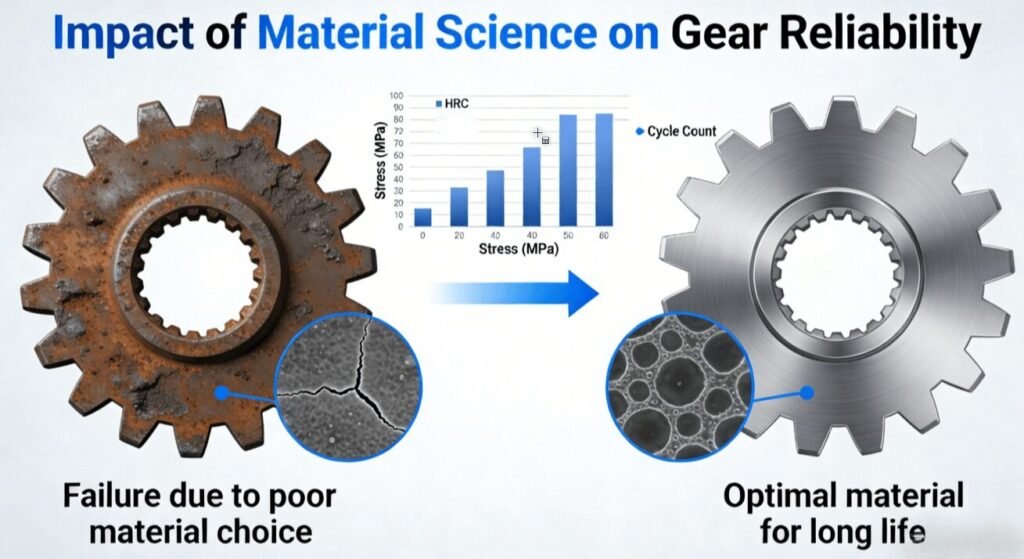
Figure 2: Material properties like hardness and toughness directly determine gear lifespan; brilliant selection prevents common failures in research applications.
The Critical Link Between Material Properties and Gear Failure
Key material properties that directly impact gear system reliability include hardness, toughness, and wear resistance. Hardness determines the gear’s ability to resist surface deformation and pitting under load. Toughness is the material’s capacity to absorb energy and resist fracture under impact loads. Wear resistance refers to the extent to which a gear surface withstands abrasive and adhesive wear over time. A mismatch between these properties and the application’s demands leads to specific failure modes.
Matching Material Performance to Operational Conditions
A systematic approach to material selection involves aligning material capabilities with the expected operating conditions. For instance, in high-load, high-cycle applications, alloy steels with surface treatments provide an excellent combination of core toughness and surface hardness. For applications requiring corrosion resistance, such as in biomedical or marine research equipment, stainless steel or engineered plastics are appropriate.
Engineering plastics are also excellent for low-speed, low-noise applications due to their inherent lubricity and quiet operation, offering a cost-effective solution for many technical project fabrication needs. Leveraging authoritative resources such as the ASM Handbook can provide critical data on material performance, ensuring that materials science applications are grounded in empirical evidence.
A Decision Framework for Material Selection
Creating a decision matrix based on load, speed, environment, and required lifespan can guide researchers. This framework helps translate complex materials science applications into practical choices, preventing costly errors arising from inappropriate material selection.
What Are the Critical Design for Manufacturing (DFM) Principles for Academic Gear Projects?
A brilliant design on paper is of little value if it cannot be manufactured reliably and cost-effectively. Design for manufacturing principles are essential for bridging the gap between innovative academic design and practical, industrial-grade production.
Core DFM Principles for Gears
The primary goals of DFM are to simplify the design, specify realistic tolerances, and select appropriate manufacturing processes. Simplification may involve avoiding unnecessary complexity in geometry. Tolerance specification is a critical balance; excessively tight tolerances increase costs exponentially without providing a proportional performance benefit, whereas overly loose tolerances can lead to poor meshing and early failure. For most university technical projects, specifying industrial-grade tolerances is often sufficient and more economical than pursuing aerospace-grade precision, unless necessary.
Balancing Innovative Design with Manufacturing Feasibility
Academic projects often push the boundaries of design, which can lead to non-standard gear geometries. While this innovation is commendable, it is crucial to consult with manufacturing experts early in the design process. Techniques such as 5-axis CNC machining or wire EDM can produce complex shapes, but they entail higher costs and longer lead times.
Adhering to professional custom gear cutting principles during the design phase can significantly improve manufacturability, reduce production costs, and prevent costly redesigns later. This collaborative approach ensures that the final design is not only innovative but also viable for prototyping, research, and beyond.
How Can Advanced Gear Grinding Services Enhance Precision Research Equipment Performance?
For research equipment where precision, efficiency, and quiet operation are non-negotiable, the manufacturing process itself becomes a key factor. Gear grinding services represent a superior finishing process that can dramatically enhance the performance of precision research equipment.
The Gear Grinding Process and Its Direct Benefits
Gear grinding is an abrasive machining process used after initial gear cutting and heat treatment. It removes small amounts of material to achieve extremely high geometrical accuracy and superior surface finish. The primary benefits include enhanced precision, reduced noise and vibration, and increased load capacity and life. This level of quality is critical for sourcing custom components for equipment that must operate continuously and reliably, such as astronomical telescopes and advanced spectroscopic instruments.
The Importance of Certified Quality in Precision Processes
Manufacturers that hold certifications such as ISO 9001 and AS9100D demonstrate a commitment to rigorous quality management systems, which are essential for processes as demanding as precision gear grinding. These certifications provide assurance that gear-grinding services are performed under controlled, repeatable conditions, thereby contributing to the reliability of the final precision research equipment.
What Certification Standards Should Academic Teams Look for in a Gear Manufacturing Partner?
When selecting a manufacturing partner, academic teams should prioritize vendors with recognized quality certifications. These certifications are independent validations of a manufacturer’s commitment to consistent quality, reliable processes, and continuous improvement.
Decoding Key Certification Standards
Several certifications are particularly relevant to precision gear manufacturing. ISO 9001 certifies that a company has established processes to ensure quality and customer satisfaction. IATF 16949 emphasizes defect prevention and the reduction of variation in the supply chain, indicating a manufacturer’s capability to produce highly consistent parts. AS9100D includes stringent criteria for flight safety, reliability, and traceability and is well-suited to meeting demanding quality requirements. ISO 14001 indicates that the manufacturer operates in an environmentally responsible manner.
A Checklist for Evaluating a Manufacturing Partner
A thorough evaluation of manufacturing partners should include verification of relevant certifications, assessment of technical capabilities and equipment portfolios, review of case studies from related fields such as research, and evaluation of their communication and project management processes. This due diligence is fundamental to successful academic project support, ensuring that the partner can fulfill their commitments and support the research project effectively. The IATF 16949 certification, in particular, offers significant value by ensuring batch-to-batch consistency and rigorous process control.
How to Establish an Effective Technical Collaboration Between Research Institutions and Manufacturing Experts?
A successful partnership between academia and industry is built on clear communication, mutual understanding, and well-defined processes. A structured technical collaboration framework is key to transforming a research concept into a reliably manufactured component.
Best Practices for a Successful Partnership
The collaboration should be viewed as a partnership from the outset. The initial phase involves clarifying the requirements. Researchers should provide the manufacturing partner with detailed information about the application, including operating loads, speeds, environmental conditions, and performance expectations. This is followed by the technical data exchange, where providing complete and accurate technical documentation is critical. The manufacturing partner’s engineers can then conduct a design review and recommend manufacturability and cost-effectiveness optimizations.
Key Phases of the Collaboration Process
A transparent process typically comprises the following steps: Initial Consultation, Design and Process Review, Formal Quotation, Production and Monitoring, and Final Inspection and Delivery. Establishing clear milestones and maintaining open communication channels throughout these phases ensures that both parties are aligned. This proactive approach to building partnerships with research institutions mitigates risks and ensures that the final product meets the exacting standards required for groundbreaking research. Following a professional engineering project support framework, as detailed by experienced manufacturers, can streamline this entire journey from concept to delivered component.
READ MORE
Conclusion
The path to avoiding costly fabrication errors in research projects is multifaceted, involving informed decisions on gear type, a deep understanding of materials science, the application of DFM principles, and the strategic use of advanced manufacturing processes such as grinding. However, the single most impactful factor is often the choice of a manufacturing partner. Such a partnership ensures that innovative research designs are realized into durable, high-performance components, safeguarding research timelines and budgets. A systematic approach to brilliant material selection and manufacturing collaboration can prevent more than 90% of common errors that plague academic gear projects.
Author Bio
This article was developed with technical support from the precision manufacturing team at JS Precision. The team holds ISO 9001, IATF 16949, AS9100D, and ISO 14001 certifications and specializes in providing custom equipment solutions for research institutions and industry.
FAQs
Q1: What is the most cost-effective material choice for low-speed academic gear applications?
A: For low-speed applications, engineering plastics such as Polyoxymethylene (POM) and nylon are typically the most cost-effective. These materials offer good wear resistance, low noise operation, and lower processing costs. The key is to evaluate the specific operating conditions, including load, environmental temperature, and lubrication, to avoid performance issues.
Q2: How long does the typical academic gear manufacturing process require?
A: A standard academic gear manufacturing process typically requires 3-5 weeks, depending on the design complexity and order quantity. Simple prototypes may be completed in as little as 2 weeks, whereas projects requiring specialized heat treatment or precision grinding may take 6-8 weeks. It is advisable to clarify the timeline with the manufacturing partner during the project planning phase.
Q3: What technical documents are essential for obtaining an accurate gear manufacturing quote?
A: A complete gear parameter sheet (including module, number of teeth, pressure angle, etc.), material specifications, a description of the operating environment, and the required precision grade are essential. CAD files and 2D drawings are mandatory. Any special requirements, such as heat treatment or surface finishing, should be clearly noted.
Q4: Can you manufacture non-standard gear geometries for specialized research equipment?
A: Yes, non-standard gear geometries can be manufactured using advanced processes such as 5-axis machining centers and electrical discharge machining (EDM). The key is to conduct a manufacturability analysis early in the design process to ensure feasibility and to balance cost with performance requirements.
Q5: How does gear grinding specifically improve performance in high-precision research applications?
A: Gear grinding improves performance by achieving sub-micron-level accuracy and superior surface finishes, with roughness values often below Ra 0.4 μm. This results in smoother transmission, lower operating noise (reductions of 5-10 dB), and longer service life, which is particularly beneficial for precision research equipment that requires continuous, reliable operation.