
How Organizations Learn to Manage Complexity
Modern organizations operate in increasingly complex environments. Globalization, digital transformation, regulatory pressure, technological interdependence, and rapidly changing customer expectations have fundamentally altered how businesses function. Complexity is no longer an exception caused by growth or disruption; it has become a permanent condition. As a result, organizations must learn to manage complexity rather than attempt to eliminate it.
Managing complexity is not about simplifying everything or imposing rigid control structures. Instead, it is about developing the organizational capacity to understand interconnected systems, adapt to uncertainty, and make informed decisions in dynamic conditions. This learning process occurs over time and involves changes in mindset, structure, methods, and tools.
Understanding Organizational Complexity
Organizational complexity arises when multiple elements interact in non-linear and unpredictable ways. These elements may include people, technologies, processes, markets, regulations, and external partners. Unlike complicated systems, which can be broken down and optimized step by step, complex systems behave differently depending on context and interaction.
For example, a change in one department’s workflow may affect productivity, employee morale, customer satisfaction, or compliance in unexpected ways. Organizations that fail to recognize these interdependencies often rely on oversimplified solutions that work temporarily but create new problems elsewhere.
Learning to manage complexity starts with accepting that not all outcomes can be predicted in advance. Instead of seeking certainty, organizations must focus on adaptability, feedback, and continuous learning.
Shifting from Linear Thinking to Systems Thinking
One of the most significant learning steps organizations take is moving from linear thinking to systems thinking. Linear thinking assumes clear cause-and-effect relationships: if action A is taken, result B will follow. While this approach works in stable environments, it becomes ineffective in complex systems where multiple variables interact simultaneously.
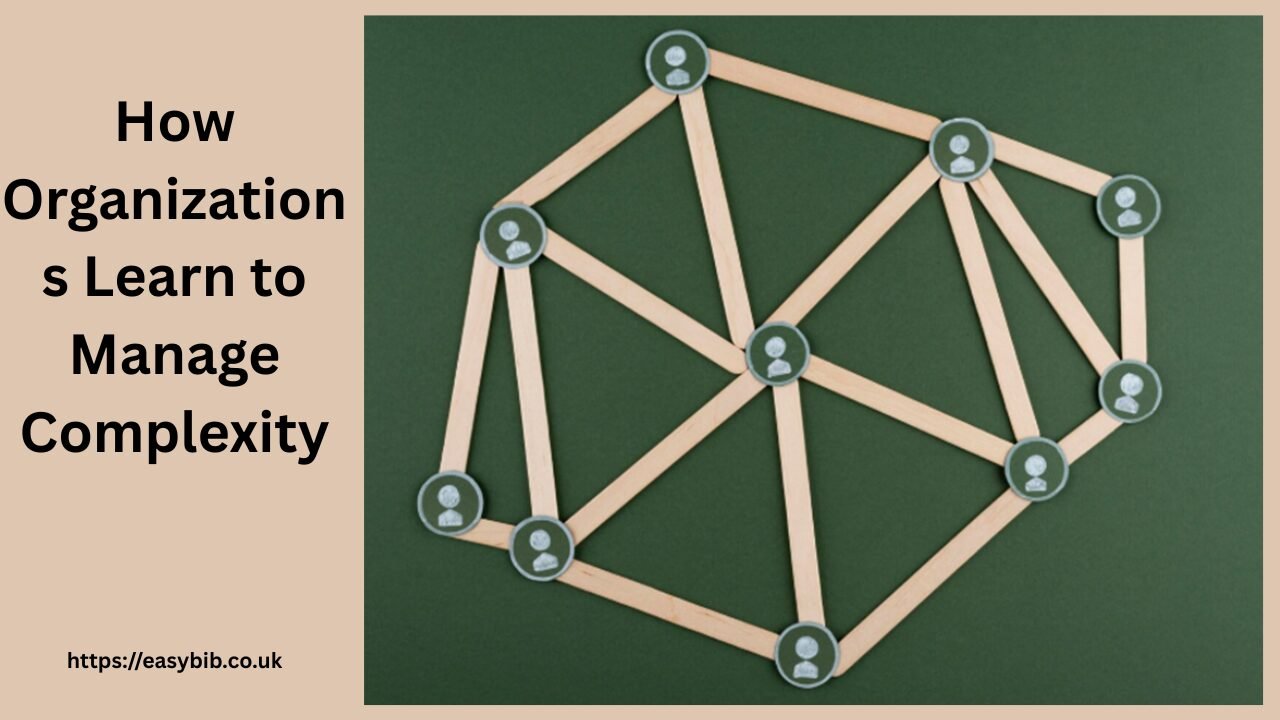
Systems thinking encourages organizations to view themselves as interconnected networks rather than isolated functions. Decisions are evaluated not only for their immediate impact but also for their ripple effects across the organization and beyond. This shift requires training leaders and teams to think holistically, recognize feedback loops, and understand long-term consequences.
Organizations often institutionalize systems thinking through cross-functional collaboration, shared performance metrics, and integrated planning processes. Over time, this collective learning improves decision quality and reduces unintended outcomes.
Learning Through Experimentation and Feedback
In complex environments, learning cannot rely solely on experience or static best practices. Conditions change too quickly, and solutions that worked before may no longer apply. As a result, organizations increasingly learn to manage complexity through experimentation. Feedback systems are essential for guiding and refining this process. This learning approach requires psychological safety. Employees must feel comfortable sharing insights, reporting failures, and questioning assumptions. Organizations that punish mistakes tend to suppress valuable information, making complexity harder to manage.
The Role of Structure and Governance
While flexibility is essential, structure still matters in complex organizations. Learning to manage complexity involves designing governance models that balance autonomy with alignment. Too much central control can slow decision-making and stifle innovation, while too little coordination can lead to fragmentation and inefficiency.
Many organizations respond by adopting hybrid structures. These may include decentralized teams operating within clearly defined strategic frameworks, or matrix structures that encourage collaboration across functions and regions. Over time, organizations learn which governance mechanisms support adaptability without sacrificing coherence.
Clear roles, transparent decision rights, and shared objectives help reduce unnecessary complexity while allowing productive variation where it adds value.
Knowledge Sharing and Organizational Learning
Complexity increases when knowledge is fragmented or trapped within silos. Organizations that manage complexity effectively invest in mechanisms for knowledge sharing and collective learning. This includes formal documentation, communities of practice, internal training programs, and digital collaboration platforms.
Learning is not limited to technical expertise. Organizations also learn how to communicate across disciplines, manage trade-offs, and interpret ambiguous information. These capabilities become part of the organization’s collective intelligence and are critical for navigating complex situations.
Over time, organizations that prioritize learning develop a stronger ability to recognize patterns, anticipate emerging issues, and respond more effectively to change.
Technology as a Learning Enabler
Technology plays a central role in helping organizations understand and manage complexity. Advanced analytics, modeling tools, and integrated information systems provide visibility into operations that would otherwise be difficult to comprehend.
For example, New Product Development tools help organizations coordinate multiple stakeholders, track dependencies, and manage uncertainty throughout the innovation process. By centralizing information and enabling collaboration, these tools support learning across product, engineering, marketing, and supply chain teams.
Similarly, Capacity planning software allows organizations to model different demand scenarios, resource constraints, and operational trade-offs. Rather than relying on static forecasts, organizations can explore alternative futures and adjust plans as conditions change. This enhances both short-term decision-making and long-term strategic learning.
Importantly, technology does not eliminate complexity; it helps organizations make sense of it. Learning occurs when teams interpret data, question assumptions, and integrate insights into their decision processes.
Leadership and Complexity Management
Leadership plays a crucial role in how organizations learn to manage complexity. Traditional command-and-control leadership styles often struggle in complex environments because they rely on centralized knowledge and predictability. In contrast, effective leaders in complex systems act as facilitators of learning rather than sole decision-makers.
These leaders encourage diverse perspectives, support experimentation, and create conditions where information flows freely. They also model adaptive behavior by adjusting strategies when new information emerges. Over time, this leadership approach shapes organizational norms and reinforces learning as a core capability.
Leadership development programs increasingly emphasize complexity awareness, systems thinking, and decision-making under uncertainty, reflecting the growing importance of these skills.
From Managing Complexity to Leveraging It
As organizations mature in their learning, complexity is no longer seen solely as a problem to be managed. Instead, it becomes a source of resilience and innovation. Diverse teams, interconnected systems, and dynamic environments can generate insights and opportunities that simpler structures cannot.
Organizations that learn effectively are better equipped to respond to unexpected disruptions, identify emerging trends, and create value in uncertain markets. Their ability to manage complexity becomes a competitive advantage rather than an operational burden.
READ MORE
Conclusion
Learning to manage complexity is an ongoing process, not a one-time initiative. It requires shifts in thinking, experimentation, knowledge sharing, supportive leadership, and the thoughtful use of technology. Organizations that embrace learning as a core function are better prepared to navigate interconnected systems and evolving challenges.
In a world where complexity continues to grow, the organizations that thrive will not be those that attempt to control every variable, but those that continuously learn how to adapt, respond, and evolve within complex environments.